

El Chip Cuántico MAJORANA: el mayor INVENTO de la Historia
Nuevo Estado de la materia?
Road Map to become Network Engineer
1. Networking Fundamentals 🛠️
Key Topics:
OSI Model
TCP/IP Model
Networking Devices (Routers, Switches, Hubs, Bridges)
2. Network Protocols 📡
Core Protocols: TCP, UDP, IP
Application Layer Protocols: HTTP, HTTPS, FTP, DNS, DHCP
Additional Protocols: SNMP, ICMP, ARP
3. Routing and Switching 🔄
Routing Protocols: OSPF, EIGRP, BGP
Switching Concepts: VLANs, STP, Trunking
Routing Concepts: Dynamic Routing vs Static Routing
4. Network Design and Architecture 🏗️
Network Topologies: Star, Mesh, Bus, Ring
Design Principles: Redundancy, Scalability, Reliability
Network Types: LAN, WAN, MAN, WLAN, VLAN
5. Network Security 🔒
Key Areas:
Firewalls
VPNs
ACLs
Security Protocols: SSL/TLS, IPSec
Best Practices for Network Security
6. Wireless Networking 📶
Wireless Standards: IEEE 802.11 a/b/g/n/ac/ax
Wireless Security: WPA2, WPA3
Wireless Network Design: Coverage, Capacity Planning
7. Cloud Networking ☁️
Cloud Networking Services: VPC, Direct Connect, VPN
Hybrid Cloud Networking: Connecting On-Premises to Cloud
Cloud Providers: AWS, Azure, Google Cloud
8. Network Automation and Scripting ⚙️
Key Focus:
Network Programmability
Automation Techniques
Scripting for Network Management (Python, Bash, PowerShell)
9. Monitoring and Troubleshooting 🧰
Key Tools:
Network Monitoring
Troubleshooting Techniques (Ping, Traceroute, Network Diagrams)
Performance Monitoring (NetFlow, SNMP)
10. Virtualization & Container Networking 📦
Focus Areas:
Virtual Network Functions (NFV)
Software-Defined Networking (SDN)
Container Networking (Docker, Kubernetes Networking)
11. Certifications 🏅
Entry-Level: CompTIA Network+, Cisco CCNA
Professional-Level: Cisco CCNP, Juniper JNCIP
Advanced-Level: Cisco CCIE, VMware VCP-NV

Mastering DNS Process
The Backbone of Digital Connectivity 🚀
The Domain Name System (DNS) is the internet’s invisible engine, translating human-readable domain names into machine-understandable IP addresses. This highly efficient system enables seamless web navigation in the background, ensuring smooth connectivity.
DNS Resolution in Action:
Query Initiation: A user enters a domain name, triggering a DNS request from their device.
Recursive Resolver: The request is handled by a recursive DNS resolver, which searches for the IP address associated with the domain.
Root DNS Server: If the resolver doesn’t have the IP cached, it queries a root DNS server for direction to the Top-Level Domain (TLD).
TLD Server: The TLD server points to the Authoritative Name Server that holds the actual IP.
Final Resolution: The Authoritative Server sends the IP address back, allowing the user’s device to connect to the website.
🔑 Why It Matters: DNS optimizes internet traffic, provides caching for speed, enhances redundancy for reliability, and supports load balancing to ensure an efficient user experience.

The Chemistry of Cybersecurity – Keeping Our Digital Spaces Safe

keeping the company’s systems and information secure is a responsibility we all share. October is Cybersecurity Awareness Month, a dedicated time when we shine a spotlight on the importance of cybersecurity and explore the ways we can all help keep Celanese cyber safe.
“While there have been significant advances in cybersecurity capabilities in recent years, there are just as many new threats to consider and protect against,” said Alan Mitchell, Chief Information Security Officer and global leader for Enterprise Physical Security. As the cybersecurity threat landscape becomes more complex by the day, companies, large and small, are dealing with threats today that didn’t exist even five years ago.
Throughout the month of October, we will delve into topics like AI-related threats, Information Classification, Data Security, Phishing (and other scams to be on the lookout for) as well as Operations Technology and industrial control systems (ICS).
We will also be introducing a year-long competition among sites with a phishing trophy awarded quarterly to the site that has the highest participation and success rate in correctly identifying and reporting test phishing emails. More details coming soon!
With the substantial growth experienced by Celanese, there is a heightened importance of ensuring our people, processes and technology are equipped to handle growing cyber risks. If you aren’t already familiar with our cyber security platform, please visit Cybersafe.celanese.com, where you can find quick tips and easy to read content about topics like phishing, ransomware, malware and more.
Each of us plays an important role in keeping Celanese cyber safe by remaining vigilant and taking proactive steps to enhance cybersecurity. Let’s commit to Keep CyberSAFE in our daily routines at work and at home to ensure we are protected in our physical and cyber worlds.
Centrix – Minova – Langreo
| Date | 13/9/2024 |
| Contract Company | Centrix Global |
| Company Info | https://centrixglobal.co.uk/ |
| Activity / Task | Cisco Switch IOS Upgrading |
| Client Company | Minova International |
| City | Langreo, Spain |
| Complete Date | 13/9/2024 |
| Job Description | Cisco Switch IOS Upgrading |
Waves Tech – Primark – Melilla
| Date | 3/9/2024 |
| Contract Company | Waves Tech |
| Company Info | https://wavestech.co/ |
| Activity / Task | Connect one BT Line and verify other 3 |
| Client Company | Primark |
| City | Melilla, Spain |
| Complete Date | 3/9/2024 |
| Job Description | 3 BT Voice Lines has been verified and a new Fiber line has been Installed |
Una Prueba de que existe el plagio o robo de tu rostro y ser utilizado en videos, o foto montajes

CLOUD NATIVE SKILLS ROADMAP
Powering Your Career with Cloud-Native Skills
In today’s rapidly evolving tech landscape, cloud-native skills are not just nice-to-have – they’re essential.
𝗪𝗵𝘆 𝗖𝗹𝗼𝘂𝗱-𝗡𝗮𝘁𝗶𝘃𝗲?
Scalability: Easily adapt to changing demands
Security: Built-in best practices for data protection
Flexibility: Adapt resources to match exact needs, potentially optimizing costs
Agility: Faster deployment and updates
Top Cloud-Native Skills to Develop:
1. Containerization (Docker, Kubernetes)
– Package and run applications consistently across environments
2. Infrastructure as Code (Terraform, CloudFormation)
– Automate infrastructure provisioning and management
3. CI/CD Pipelines (Jenkins, GitLab CI, GitHub Actions)
– Streamline software delivery and deployment processes
4. Observability & Monitoring (Prometheus, Grafana)
– Gain insights into application performance and health
5. Cloud Security
– Implement best practices for securing cloud-native applications
6. Serverless Computing (AWS Lambda, Azure Functions)
– Build and run applications without managing servers
7. Microservices Architecture
– Design scalable and maintainable distributed systems
8. Cloud Databases (Amazon DynamoDB, Google Cloud Spanner)
– Leverage managed database services for scalability and performance
Investing in these skills can open doors to exciting opportunities in cloud engineering, DevOps, and platform development roles.
Which of these skills are you currently focusing on?
Any others you’d add to the list?
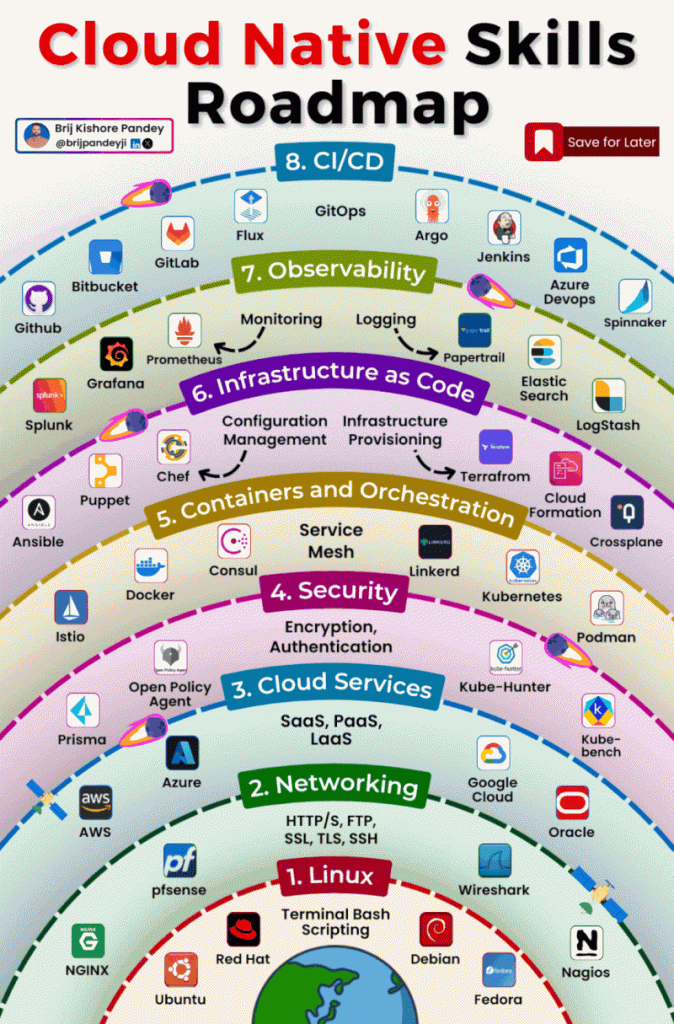
Credit to: Brij kishore PandeyBrij kishore Pandey